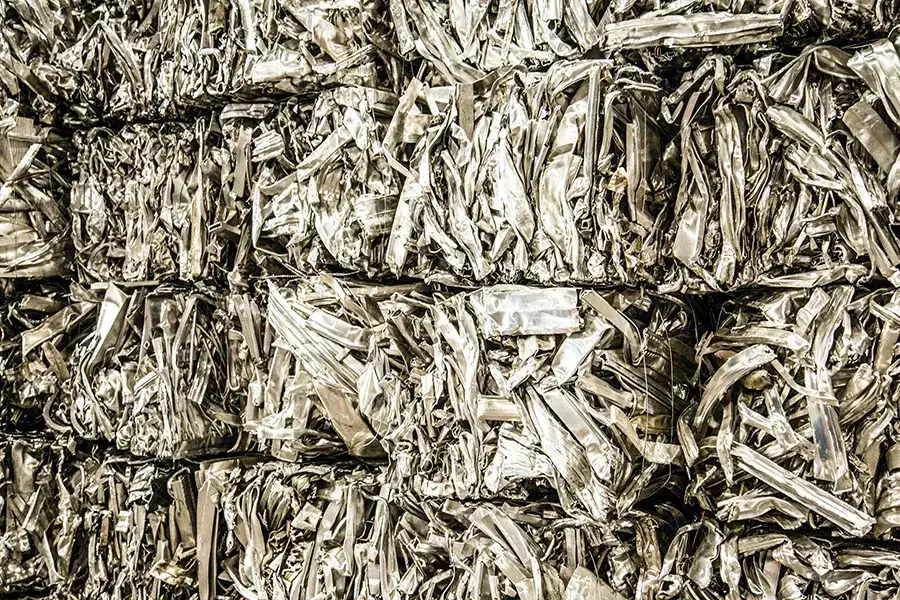
Aluminum bundles
Aluminum bundles recycling

Machines and plants for aluminum bundles recycling

Bundled aluminum usually refers to aluminum scrap compressed into blocks or bales for easy transportation and storage. This process is common in the recycling industry, where large quantities of used aluminum, such as cans or industrial waste, are collected, compacted, and shipped to recycling plants.

At this stage, in order to maximize the value of the material, shredding, cutting, and separation equipment must be used in to downsize the material for effective separation.

The perfect combination is the Blue Devil Twin shaft shredder, (which opens the bales), combined with the Blue Shark Hammer Mill, which further shreddes the material in to small enough components to allow the Blue Sorter Separation Line, to finishes the processes by cleaning and separating the different materials.

Our solutions

Hammermill Shredders
BlueShark

Twin-Shaft Shredders and Pre-Shredders
BlueStorm

Single-Shaft Shredders
Blue Marlin

Metal Separation Plants
BlueSorter

FAQ

How can CO₂ emissions be reduced in aluminum production?

Aluminum is 100% recyclable, and using aluminum scrap can cut CO₂ emissions by up to 95% compared to primary production. However, the scrap must be properly processed to meet the chemical specifications required by foundries. Zato has been designing advanced shredding systems for years to prepare scrap efficiently and ensure its suitability for sustainable remelting, significantly reducing the environmental impact of aluminum production.

How to shred automotive production scrap (engines, chassis, frames)?

Modern automotive scrap – such as frames, chassis, and engine blocks made of aluminum alloys – often comes from press or giga-press casting processes and is chemically homogeneous and free of contaminants. To optimize recycling, it is essential to reduce particle size and prepare the material for remelting. The Blue Devil twin-shaft shredder is the ideal solution: it offers high reliability, low wear, and controlled output size, ensuring smooth downstream melting processes. Thanks to our extensive industry experience, we provide a proven technology suitable for high-efficiency production lines.

What is the best aluminum de-baler?

For de-baling aluminum profile or sheet bales, the twin-shaft shredder is the most efficient and widely used solution in large European foundries. It delivers consistent output size, high density, and excellent preparation for downstream separation or melting. For more demanding applications—such as processing aluminum cans or salt slag blocks—the shredder can be equipped with a pusher to improve material feed. After de-baling, the material is typically processed further with a single-shaft shredder or a hammer mill to achieve higher cleanliness and compaction.

How is painted or contaminated aluminum cleaned (e.g. thermal break, zinc alloys, iron, glass)?

For aluminum contaminated with firmly attached impurities like paint, thermal breaks, zinc alloy (zamak), iron, or glass, the most effective solution is a hammer mill. Through high-impact action, it breaks down the material to optimal particle size while efficiently separating different components. It also partially removes paint layers, resulting in a cleaner and higher-purity aluminum output.

How can fine generation be reduced when processing aluminum?

Minimizing fines starts with selecting the right technology for the type of aluminum being processed. While hammer mills offer excellent separation, in many cases a low-speed single-shaft shredder is sufficient. This solution helps reduce fine generation, improves material densification, and facilitates the removal of contaminants, resulting in a cleaner and more efficient process.

What type of plant is needed to process aluminum?

The choice of equipment depends on the input material and the desired final output.
A hammer mill is essential when furnace-ready material is the goal. For internal scrap or densifying relatively clean aluminum (such as wheels or engine blocks), a twin-shaft or single-shaft shredder is more suitable.
Each application requires a tailored solution, which is why we evaluate both the material and your production needs to recommend the most appropriate technology.

Go to Top